Imagine that it’s your first day at a new school. You don’t know any of the other students, and you’re hoping to make some friends. Another student comes up to you and asks about your teachers and class schedule. Could this person be a friend? Or a bully?
You see the student again later the same day in the hallway. What do you do? How does your brain interpret the earlier social interaction to help you figure out how to react now?
These questions loom large for us because humans are fundamentally social creatures. This means that our survival depends on cooperation with others and our ability to distinguish friends from enemies. The mental processes that allow our brains to interpret and respond to social interactions are called social cognition.1Social cognition: Mental processes involved in thinking about, perceiving, and interpreting the social behavior of ourselves and others. https://dictionary.apa.org/social-cognition One part of social cognition is evaluating the emotional quality of a social interaction, called social valence.2Social valence: The positive or negative emotional impression of a social interaction. https://psychologydictionary.org/valence/
The specific mechanisms and processes involved in social cognition are poorly understood. We do know that deficits in social cognition are found in people with mood disorders3Mood disorder: A mental health condition that affects one’s emotional state, such as depression or bipolar disorder. https://my.clevelandclinic.org/health/diseases/17843-mood-disorders and autism spectrum disorders.4Autism spectrum disorder: A neurological and developmental disorder that can impact how an individual communicates, behaves, and interacts with others. https://www.nimh.nih.gov/health/publications/autism-spectrum-disorder In people who struggle with social cognition, difficulty in interpreting the meaning of social interactions can make it hard to make friends and have stable relationships, as well as impact their quality of life in other ways.
For example, let’s assume that the student in the above scenario was being quite friendly and trying to help you out on your first day of school. This was meant to be a positive social interaction. If you interpreted the interaction in this way, you might say hello again to this student in the hallway the next time you see them.
However, if you struggle with interpreting social interactions, you might misinterpret this interaction in a negative way and not talk to the other student again. This person could have been a new friend at your new school, but now they won’t be. If this happens repeatedly, you might find yourself struggling to make friends or unable to connect with other people, which can translate into difficulties in other aspects of life. This is because repeated positive or negative social interactions affect how much social interaction an individual seeks out.
“These challenges are rooted in the inability to correctly interpret social interactions,” explained Dr. Xiaoting Wu, Assistant Professor of Neuroscience at the Icahn School of Medicine at Mount Sinai in New York City. Dr. Wu’s research seeks to understand the brain mechanisms involved in social cognition and how we interpret social interactions. Recently, Dr. Wu and her team identified specific regions and molecules in the brain involved in regulating positive and negative impressions of social interactions. The researchers hope these findings will help spur novel therapies for people with deficits in social cognition that negatively impact their lives.
Building on the Work of Others
Dr. Wu’s research builds on the work of previous scientists who identified the brain regions involved in social cognition and studied social cognition in both human and mouse models. About a decade ago, researchers demonstrated that the hippocampus5Hippocampus: Region of the brain typically associated with memory. https://www.britannica.com/science/hippocampus is an important brain region involved in social cognition. The hippocampus is part of the limbic system6Limbic system: A network of brain structures involved in regulating emotions, behavior, and memory. https://www.simplypsychology.org/limbic-system.html, a network of brain structures involved in regulating emotions, behavior, and memory.
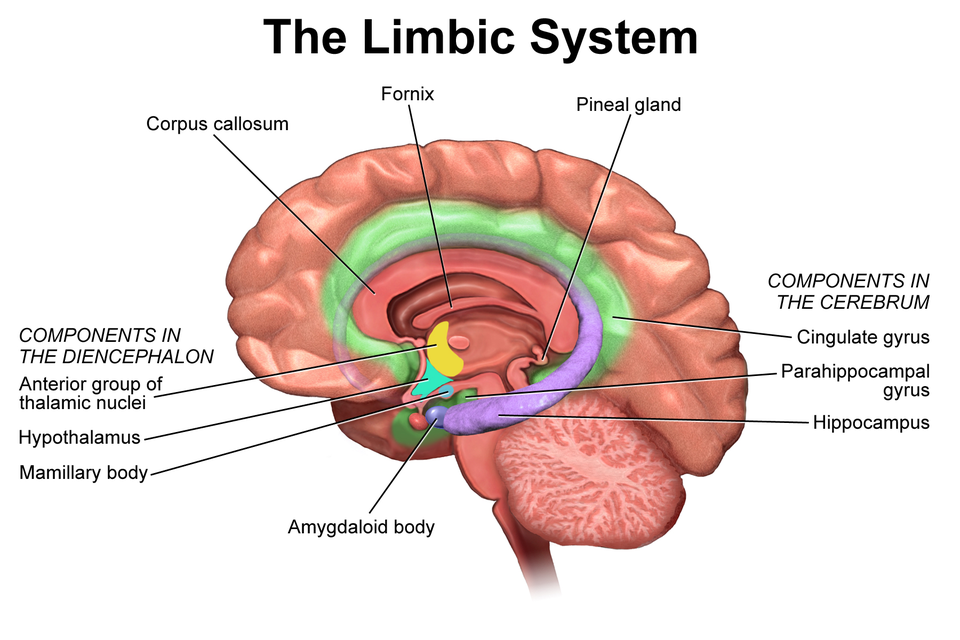
The limbic system, including the hippocampus (in purple).
[Source: https://commons.wikimedia.org/wiki/File:Blausen_0614_LimbicSystem.png]
The hippocampus is typically associated with learning, memory, and cognition, and different subregions within the hippocampus are involved in different aspects of these functions. Areas of the hippocampus are described as either dorsal (upper regions) or ventral (lower regions). These researchers showed the CA1 subregion of the ventral hippocampus was responsible for social cognition.
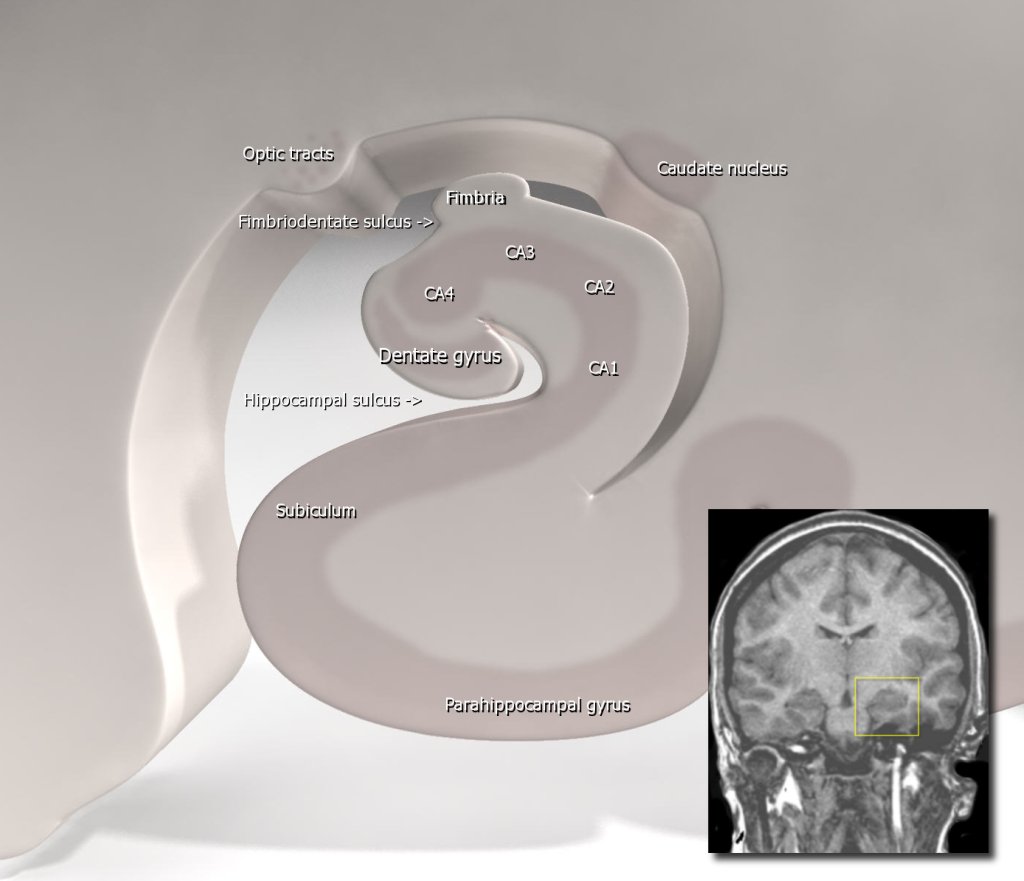
Regions of the hippocampus and surrounding structures, including the CA1 subregion.
[Source: Frank Gaillard https://en.wikipedia.org/wiki/Hippocampus_anatomy#/media/File:Hippocampus_(brain).jpg]
Based on these findings, initial experiments in humans tried to understand what was happening in the ventral CA1 subregion of the hippocampus during social interactions. This was a challenging undertaking, since it is almost impossible to control for the multitude of variables that make up human lives and social experiences. Most of this research in humans focused on neutral social interactions—interactions that were neither positive nor negative. “But most of our daily social interactions are not neutral,” remarked Dr. Wu. “These experiments were more tests of memory than social cognition.”
Developing A Research Paradigm
Dr. Wu chose to conduct her research in mouse models to more deeply understand what was happening at the cellular level during social cognition processes. “Obviously humans and mice have different social worlds,” she explained, “but working with mice gives us a window into the underlying mechanisms of social cognition that we cannot get with humans.”
Working with mouse models presents its own set of challenges, though. In human experiments, the researchers can ask the research subjects whether a certain social interaction was positive or negative. Since researchers cannot directly ask mice these questions, they must instead infer the mouse’s response based on its behavior in a certain situation. Dr. Wu set out to design an experiment that would model exposure to both positive and negative experiences in mice.
In the model Dr. Wu developed, the subject mouse was exposed to a neutral (control) mouse for 5 minutes and an experimental mouse for another 5 minutes. After a 5-minute break, the mouse was placed in a three-chamber box between the neutral mouse and the experimental mouse. The amount of time the subject mouse spent close to either the neutral or experimental mouse indicated if the subject mouse interpreted the previous interaction with the experimental mouse as positive or negative.
The negative social interaction was based on aggressive behavior between mice. Different types of mice are known to be more aggressive than others. The researchers used a bigger, more aggressive type of mouse as the experimental mouse for a negative social interaction. The subject mouse would spend 5 minutes with this aggressive experimental mouse, and 5 minutes with a neutral mouse. To test the social valence of the interaction, the subject mouse was then placed into a three-chamber box with the aggressor mouse on one side and the neutral mouse on the other side, both under a cup.
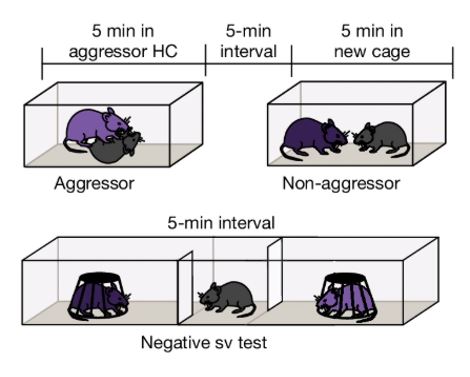
Experimental model to assess negative social valence (sv) in mice. The subject mouse (grey) was placed into the aggressor’s cage (left) for 5 minutes and a neutral (non-aggressor) mouse’s cage for 5 minutes. Then the mouse was placed in a three-chamber box between the aggressor and non-aggressor. The researchers assessed social valence based on the amount of time the subject mouse spent in each chamber.
[Source: Zorab et al. 2025, Fig 1a]
The subject mouse demonstrated their preference for the aggressor or neutral mouse based on the amount of time spent in the areas surrounding them. Nearly all the mice tested in this way showed a preference for the neutral mouse, indicating a strong negative social valence towards the aggressor mouse. Importantly, without prior interaction, the subject mice did not show a preference in the choice test.
An experimental model to simulate a positive social interaction was more challenging, because positive experiences typically need to be much stronger for mice (or humans) to show a preference later on. The researchers used the concept of a potential mate because male mice strongly prefer female mice. Both the neutral and experimental mice were females around the same age. The experimental mice exhibited mating behaviors, which were later shown to be strongly preferred by the male subject mice.
The subject mouse spent 5 minutes with a potential mate, and 5 minutes with a neutral mouse. The social valence of the interaction was tested using the same three-chamber box with the potential mate on one side and the neutral mouse on the other.
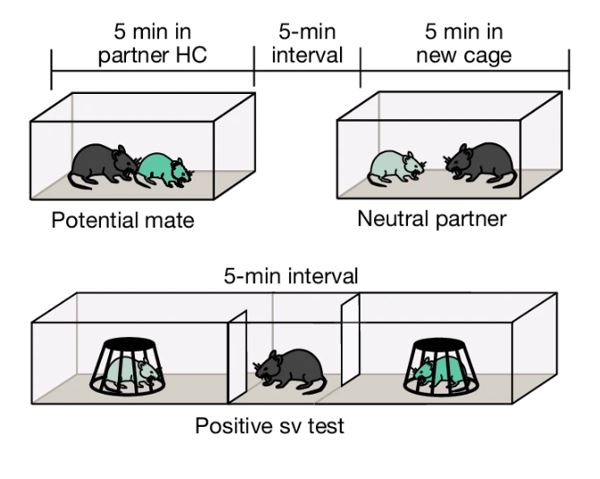
Experimental model to assess positive social valence (sv). The subject mouse (grey) was placed into the potential mate’s cage (left) for 5 minutes and a neutral mouse’s cage for 5 minutes. Then the mouse was placed in a three-chamber box between the potential mate and neutral partner. The researchers assessed social valence based on the amount of time the subject mouse spent in each chamber.
[Source: Zorab et al. 2025, Fig 1b]
The subject mouse demonstrated their preference for the potential mate or neutral mouse based on the amount of time spent in the areas surrounding them. Nearly all the mice tested in this way showed a preference for the experimental mouse, indicating a strong positive social valence towards the potential mate.
Assessing the Mechanisms of Social Cognition
Once Dr. Wu and colleagues established their model for assessing positive and negative social valence in mice, they tested the brain regions involved in these social cognition processes. They confirmed that the ventral CA1 region of the hippocampus was activated during these experiments. In addition, the researchers found when the ventral CA1 region was inactivated, the mice exhibited impaired social cognition. The researchers identified two related but separate populations of neurons in the CA1 region, one associated with impaired negative social valence, and one associated with impaired positive social valence.
Based on these results, the researchers hypothesized that different neuromodulators7Neuromodulator: A chemical that alters the activity of neurons indirectly, without directly triggering a response. https://biocascades.com/articles/understanding-neuromodulators-function-implications/ may be involved in social cognition processes. Neuromodulators are substances that alter the activity of neurons indirectly, without directly triggering a response. The researchers performed experiments to observe the neuromodulators released from the ventral CA1 regions of interest. They found that the neuromodulators serotonin8Serotonin: A chemical messenger in the brain involved in thinking, mood, and sleep, among other functions. https://www.simplypsychology.org/what-is-serotonin.html and neurotensin9Neurotensin: A chemical messenger affecting different parts of the body; in the brain, neurotensin plays a role in social behavior and regulating hormones. https://en.wikipedia.org/wiki/Neurotensin released into the ventral CA1 region influenced social valence. Serotonin and the serotonin 1b receptor were associated with positive social valence; neurotensin and the neurotensin 1 receptor were associated with negative social valence.
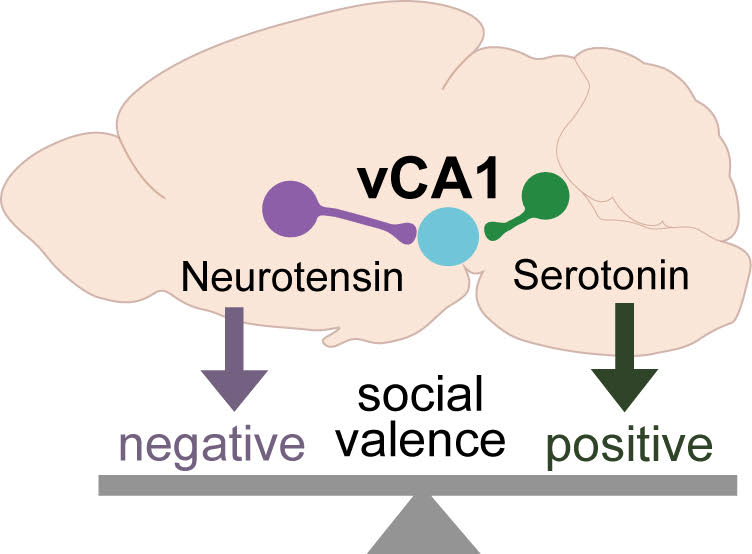
The researchers found that different neuromodulators released into the ventral CA1 region of the brain influenced social valence. Neurotensin (purple) was associated with negative social valence and serotonin (green) was associated with positive social valence.
[Source: Dr. Wu]
Next, Dr. Wu and colleagues wanted to know if they could improve social cognition in a mouse model with social cognition deficits. For this series of experiments, the researchers used a mouse model with a mutation in the SHANK3 gene. Mice with this genetic mutation show characteristics of impaired positive social valence. In the experimental paradigm testing positive social valence, these mice did not show a preference for either the control or experimental mice. However, when the researchers activated the serotonin 1B receptor in these mice, their ability to detect positive social valence improved. “This is a really exciting result,” concluded Dr. Wu.
In ongoing research, Dr. Wu continues to further define the neurons of the CA1 region and the specific mechanisms that regulate social cognition. In future experiments, Dr. Wu plans to investigate how emotional perceptions of social interactions influence social seeking behavior. She hopes this research will continue to spur new interest in treatment options that may one day help to improve social cognition in people with social cognition deficits.
Dr. Xiaoting Wu is Assistant Professor of Neuroscience at the Icahn School of Medicine at Mount Sinai in New York City. Her research seeks to understand the brain mechanisms involved in social cognition and how we interpret social interactions. When not in the laboratory, Dr. Wu enjoys traveling and hiking. Her favorite National Park in the US is Yosemite.
- Zorab JM, Li H, Awasthi R, et al. Serotonin and neurotensin inputs in the vCA1 dictate opposing social valence. Nature. 2025 Jun;642(8066):154-164. doi: 10.1038/s41586-025-08809-2. Epub 2025 Apr 30. https://www.nature.com/articles/s41586-025-08809-2
- Wu Lab. https://labs.neuroscience.mssm.edu/project/wu-lab/
- “Mechanism by Which the Brain Weighs Positive vs. Negative Social Experience Is Revealed.” https://www.mountsinai.org/about/newsroom/2025/mechanism-by-which-the-brain-weighs-positive-vs-negative-social-experience-is-revealed
- Written by Rebecca Kranz with Andrea Gwosdow, PhD at https://www.gwosdow.com