
What does your hair say about you? Hair color and styles have always been an important component of human self-expression. But your hair can share more about you than just your personality. Research in recent decades has shown that levels of stress hormones1Hormones: Chemical messengers that travel through the bloodstream to act on other organs and tissues and change biological functions. https://nigms.nih.gov/biobeat/2024/07/what-is-a-hormone in your hair can serve as an estimate of your stress levels. This can be especially important for younger children who may not yet have the language to express how they are feeling.
New research by Emma Littler in the laboratory of Dr. Mark Ferro and colleagues at the University of Waterloo School of Public Health Sciences in Waterloo, Canada uses stress hormone levels in hair samples to understand the experiences of children and adolescents with chronic physical illnesses such as asthma2Asthma: A chronic respiratory disease leading to inflammation and narrowing of the airways. https://www.nhlbi.nih.gov/health/asthma and diabetes3Diabetes: Class of chronic medical conditions characterized by the body’s inability to utilize sugar. https://www.cdc.gov/diabetes/about/?CDC_AAref_Val=https://www.cdc.gov/diabetes/basics/diabetes.html. The researchers hope that this study sheds light on the stress experienced by children and adolescents with chronic physical illnesses so that they can be better supported in managing their illnesses and their mental health.
Children’s Mental Health and Chronic Physical Illness
Emma Littler became interested in studying children’s mental health because most mental health disorders4Mental health disorder: Condition involving changes in emotion, thinking, and behavior. https://www.psychiatry.org/patients-families/what-is-mental-illness have their first onset in adolescence. Half of mental health disorders appear before age 14 and 75% begin before age 21. “If we want to prevent mental health disorders, or prevent them from getting worse, we have to focus on children,” Emma commented.
It is well established that stressful events during childhood can impact mental health. Much of the research into stress and mental health has focused on traumatic events or violence that a child may have experienced. For example, a previous Science Matters story, “What Your Teeth Know,” compared stress lines in the teeth of mothers who had experienced a stressful event during pregnancy such as the death of a partner, child, friend, or relative, to those who had not.
There are good reasons for focusing on these types of childhood stressors. For her research, Emma decided to focus on an overlooked form of childhood stress: chronic physical illness. In Canada, where this study took place, an estimated 40% of children live with a chronic physical illness such as asthma, diabetes, and juvenile arthritis5Juvenile arthritis: Inflammation of the joints in children and adolescents; the most common form of arthritis in children. https://orthoinfo.aaos.org/en/diseases–conditions/juvenile-arthritis/. “We know that children with chronic physical illnesses have higher rates of mental health disorders as they age,” added Emma, “but the risk factors behind these increased rates are not well understood.”
Understanding the Stress Response
Emma hypothesized that clues to understanding the connection between chronic physical illnesses and mental health disorders might lie in an individual’s stress response6Stress response: Biological and psychological responses activated by a stressful event. https://www.simplypsychology.org/stress-biology.html. The stress response, also commonly known as the “fight or flight” response, describes a series of responses in the brain and body that are activated by a stressful event.
From an evolutionary perspective, the stress response was critical to our survival as a species because it helped us adapt to a changing environment. For example, imagine you’re taking a walk in the woods, and a giant bear (or other large animal) blocks your path. You must decide very quickly whether and how you might get out of the way to make sure you survive the experience.
The body’s response to stress begins in the hypothalamus7Hypothalamus: Area of the brain responsible for maintaining your body in a stable state; regulates body temperature, blood pressure, metabolism, and sleep, among other functions. https://my.clevelandclinic.org/health/body/22566-hypothalamus, one of the oldest parts of the brain responsible for maintaining your body in a stable, balanced state. When activated by stress, the hypothalamus releases the hormone corticotropin-releasing hormone (CRH), which travels in the bloodstream to the pituitary gland8Pituitary gland: A small gland in the base of the brain that produces hormones in response to activation from the hypothalamus. https://www.cancer.gov/publications/dictionaries/cancer-terms/def/pituitary-gland.
The pituitary gland is a small, hormone-producing gland located at the base of the brain. In response to receiving CRH from the hypothalamus, the pituitary releases the hormone adrenocorticotropic hormone (ACTH). ACTH travels in the blood from the pituitary to the adrenal glands9Adrenal glands: Small glands located above the kidneys that produce hormones including cortisol. https://www.cancer.gov/publications/dictionaries/cancer-terms/def/adrenal-gland, located just above the kidneys. Upon sensing an increase in ACTH, the adrenal glands release the stress hormone cortisol. Cortisol provides the extra energy you need to respond to the stress. It also regulates your metabolism10Metabolism: The processes through which the body turns the food and drink we consume into energy. https://my.clevelandclinic.org/health/body/21893-metabolism.
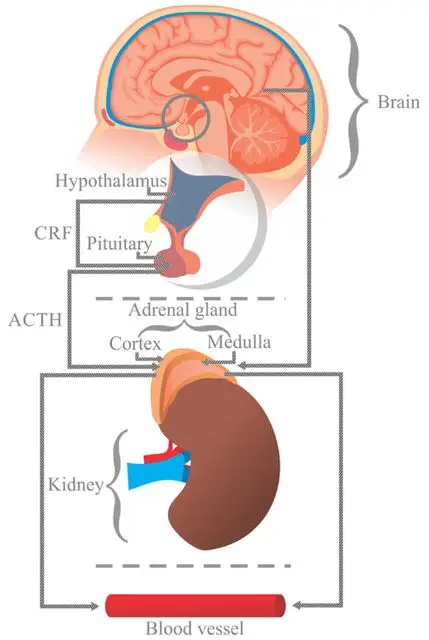
[Source: https://commons.wikimedia.org/wiki/File:Response_to_stress.jpg]

The parts of the body involved in the stress response are known as the hypothalamic-pituitary-adrenal axis or HPA axis. The HPA axis has a built-in negative feedback loop. When cortisol levels get high enough, cortisol acts on the hypothalamus to stop releasing CRH, which in turn signals the pituitary to stop releasing ACTH. This process brings the HPA axis back into balance.
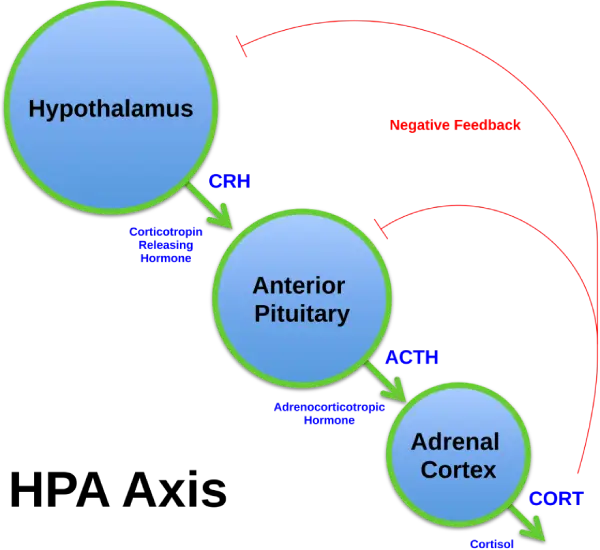
[Source: https://commons.wikimedia.org/wiki/File:HPA_Axis_Diagram_(Brian_M_Sweis_2012).svg]
.svg)
Like other systems in the body, the HPA axis and the stress response can become dysregulated. Imagine, for example, that a bear jumped into your path nearly every day. Some people might adapt to the stressful experience of seeing a bear daily so that it no longer prompted the same fight-or-flight response. Other people, though, might struggle to adapt.
For those struggling to adapt, the stress response can become chronically active, leading to abnormally high or low cortisol levels. Since the body wants to be in balance, this dysregulation can affect many other functions in the body. These effects might not necessarily be perceived by an individual experiencing chronic stress, especially if that person is young.
Although daily encounters with a bear are rather unlikely, depending on where you live, causes of chronic stress are all around us. For example, it is well documented that chronic illnesses can lead to chronic stress. Aside from the initial shock of a diagnosis, chronic illnesses like asthma and diabetes may require frequent medications, doctor’s visits, and a certain amount of unpredictability because the illness can change over time. Emma and other researchers hypothesize that the ongoing stress of a chronic illness may be one of the factors leading to increased numbers of people with chronic illnesses who also have mental health disorders compared to the general population.
To better understand the relationship between chronic physical illnesses and chronic stress in young people, Emma turned to a recent research development that has identified cortisol levels in hair strands as an indicator of stress.
Stress in the Strands
One of the first studies to propose a relationship between the concentration of stress hormones in hair strands and stress levels was conducted on rock hyraxes, a rodent native to the Middle East and Africa.


The researchers wanted to monitor the stress levels of these animals in a noninvasive way and turned to cortisol levels in hair samples taken from animals that were captured and released. Since that time, numerous studies have helped establish the use of hair cortisol levels as a proxy for stress in both humans and animals.
When cortisol is released into the bloodstream as part of the stress response, some of the hormones are deposited in different areas of the body. Hair follicles11Hair follicle: A tube-like structure in the skin where hair grows. https://my.clevelandclinic.org/health/body/23435-hair-follicle, the base of our strands of hair, are one place where cortisol gets deposited. This means that levels of cortisol in the hair can serve as an indicator not only of stress in the moment but in the past 1-2 months.
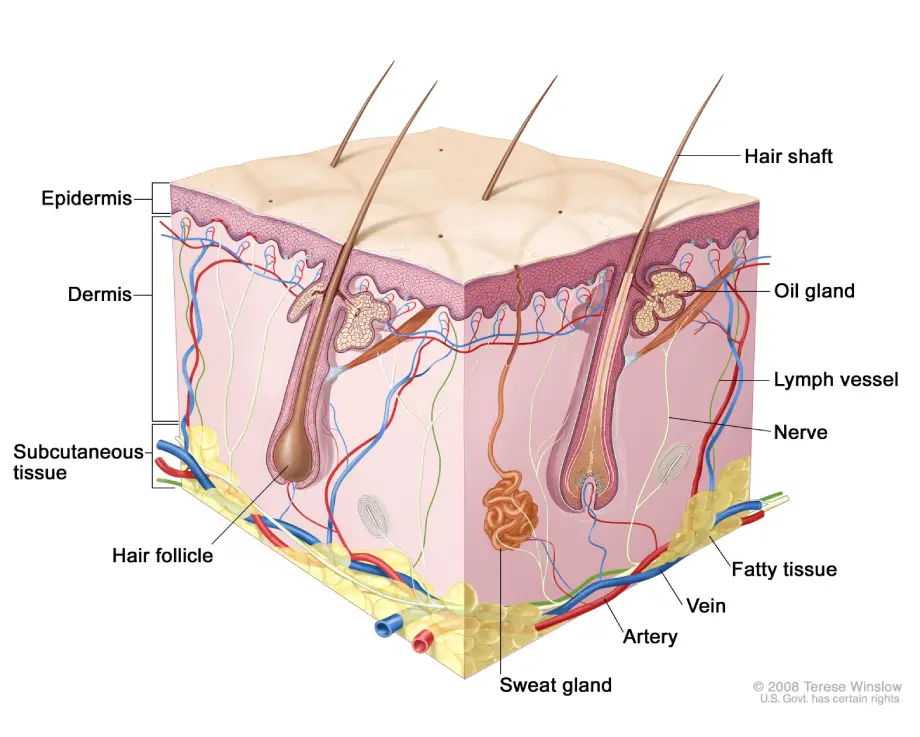
[Source: https://nci-media.cancer.gov/pdq/media/images/579036.jpg]
Connecting Chronic Physical Illnesses and Stress
To examine the relationship between childhood chronic physical illnesses and stress, Emma utilized data from an ongoing study called Multimorbidity in Children and Youth Across the Life Course, or MY LIFE for short. The MY LIFE study enrolled children between the ages of 2 and 16 years with chronic physical illnesses and their parents and continues to follow them to this day. Emma used data from participants for the first 48 months (4 years) of the study. Chronic physical illness was defined as a condition expected to last at least one year or more that resulted in physical or functional limitations, dependency on treatment or medication, or increased use of health care services. The most common chronic physical illnesses in the sample were juvenile arthritis, type 1 diabetes12Type 1 diabetes: An autoimmune disease that causes a lack of insulin, a hormone needed to control blood sugar. https://my.clevelandclinic.org/health/diseases/21500-type-1-diabetes, celiac disease13Celiac disease: An autoimmune disease leading to damage to the intestines triggered by eating gluten. https://www.niddk.nih.gov/health-information/digestive-diseases/celiac-disease/definition-facts, cystic fibrosis14Cystic fibrosis: A genetic disorder affecting the lungs, pancreas, and other organs. https://www.cff.org/intro-cf/about-cystic-fibrosis, and hemophilia15Hemophilia: A bleeding disorder where blood does not clot properly. https://medlineplus.gov/hemophilia.html.
As part of the MY LIFE study, the researchers collected hair samples at baseline and continue to collect samples regularly. For this study, Emma used samples collected at baseline, 6, 12, 24, and 48 months. At the beginning of the study, parents would bring their children into the research facility to collect the samples. During the COVID-19 pandemic, the protocol changed so that parents would collect the hair samples directly from their child and mail them in. The researchers needed approximately 80 strands of hair, about one-quarter inch in diameter, to analyze the samples. Parents were also asked about factors that are known to influence the amount of cortisol in the hair including hair color, the frequency of hair washing, and smoking in the home.
At each of these time points when hair was collected, parents also filled out the Emotional Behavioural Scales checklist that asks about their child’s mood and behavior over the past 6 months. The checklist includes symptoms of common mental health disorders including depression16Depression: A common and serious condition that can negatively affect how you feel, think, and act. https://www.psychiatry.org/patients-families/depression/what-is-depression, anxiety17Anxiety disorder: A common and serious condition characterized by fear and dread out of proportion to a given situation. https://my.clevelandclinic.org/health/diseases/9536-anxiety-disorders, and attention-deficit hyperactivity disorder18Attention-deficit hyperactivity disorder: A developmental disorder characterized by difficulty focusing, hyperactivity, and impulsiveness. https://www.psychiatry.org/patients-families/adhd/what-is-adhd (ADHD).
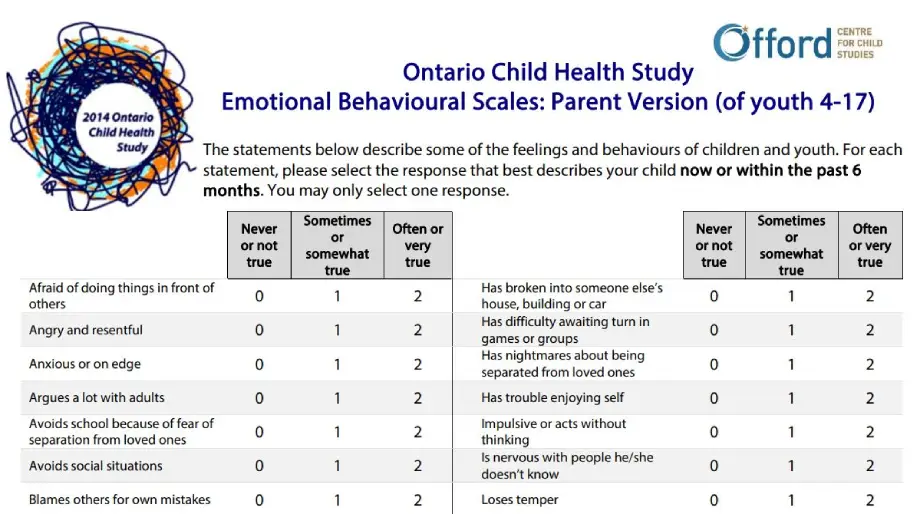
[Source: https://ontariochildhealthstudy.s3.amazonaws.com/uploads/OCHS-EBS_Parent-1.pdf]
By the time Emma analyzed the data from the MY LIFE cohort, the project had already been running for over 4 years. Her sample included a total of 244 child-parent pairs who had completed the questionnaires and submitted the hair samples for at least one time point.
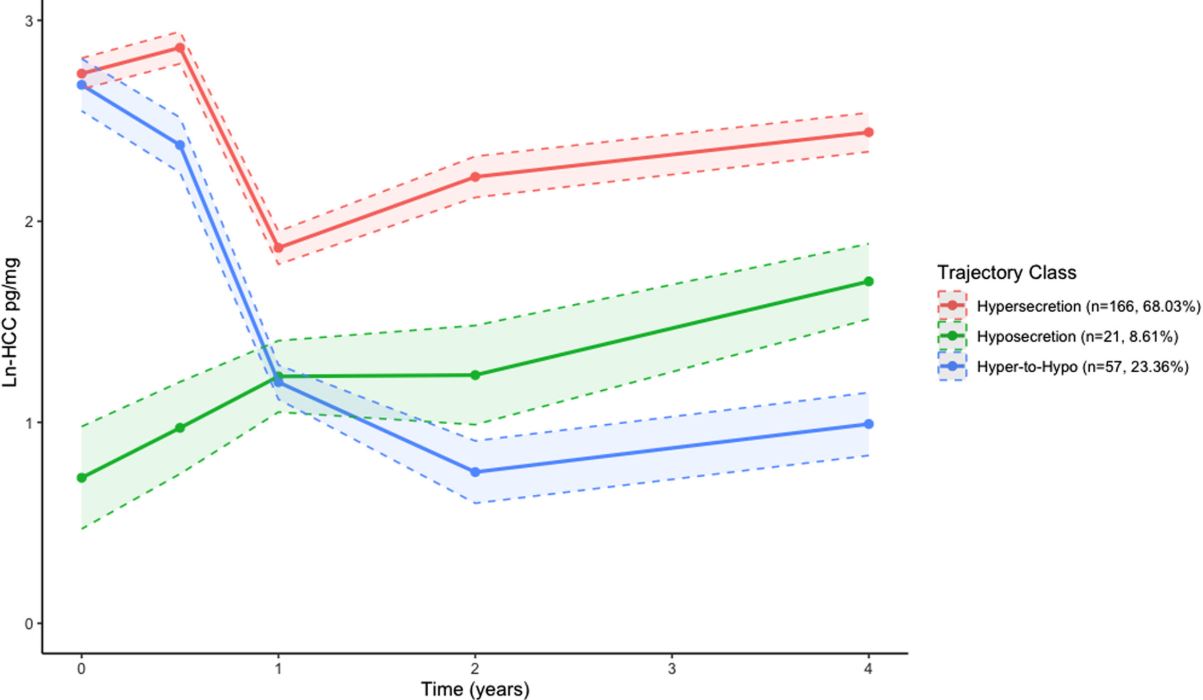
After analyzing the data, Emma noticed three different patterns of cortisol levels in the hair samples of study participants:
- Hypersecretion: Participants had elevated hair cortisol levels at baseline that remained elevated over the course of the study
- Hyposecretion: Participants had low levels of hair cortisol at baseline that remained low over the course of the study
- Hyper-to-Hypo: Participants initially had elevated hair cortisol levels at baseline that decreased after 12 months and remained low thereafter
[Source: Littler et al 2025, Fig 1]
Over two-thirds of participants (n=166) followed the Hypersecretion pathway, with higher-than-average cortisol levels throughout the study period. This suggests that children with a chronic physical illness are experiencing more stress on an ongoing basis than their peers without a chronic physical illness. In addition, the parents of these children reported that their child had more mental health symptoms. Emma hypothesizes that children in this group may have dysregulation in the HPA axis that puts them at greater risk for developing a mental health disorder in the future.
Less than 10% of participants (n=21) followed the Hyposecretion pathway. Most of these children had received their diagnosis longer in the past, so this may represent healthy adaptation to the chronic stress of a chronic physical illness. On the other hand, consistently low levels of cortisol can also indicate dysregulation in the HPA axis, so the overall meaning of this result is unclear.
About one-quarter of participants (n=57) followed the Hyper-to-Hypo pathway. Emma believes that this group represents a healthy adjustment to the stress of a chronic physical illness. Initially, stress levels increase and cortisol levels also rise. Over time, these cortisol levels come back into normal range as the individual adapts to their new situation. The parents of participants in this group reported fewer mental health symptoms in their children.
In future work, Emma hopes to continue to follow the MY LIFE study participants over time. In addition, she plans to expand her analysis to include mental health symptoms reported by the parents of children in the study. Just as it can be stressful for children with a chronic physical illness, it can also be stressful for their parents. Emma is interested in how a child’s chronic physical illness impacts parents’ mental health, and how that can, in turn, affect the mental health of their child.
Emma Littler is a PhD student in the laboratory of Dr. Mark Ferro at the University of Waterloo School of Public Health Sciences in Waterloo, Canada. Her research focuses on the relationship between childhood stress and the development of mental health disorders. When not in the laboratory, Emma enjoys sewing and watching Formula 1 racing.
- Littler EAL, Butt ZA, Gonzalez A, Ferro MA. Association Between Hair Cortisol and Psychopathology in Children With a Chronic Physical Illness. Stress Health. 2025 Aug;41(4):e70087. https://onlinelibrary.wiley.com/doi/10.1002/smi.70087
- Ferro MA, Lipman EL, Van Lieshout RJ, Timmons B, Shanahan L, Gorter JW, Georgiades K, Boyle M. Cohort Profile: Multimorbidity in Children and Youth Across the Life-course (MY LIFE) Study. J Can Acad Child Adolesc Psychiatry. 2021 May;30(2):104-115. https://pmc.ncbi.nlm.nih.gov/articles/PMC8056956/
- American Psychological Association. “Stress effects on the body.” https://www.apa.org/topics/stress/body
- Harvard Health. “Understanding the stress response.” https://www.health.harvard.edu/staying-healthy/understanding-the-stress-response
- Nationwide Children’s. “Physiological stress response: It’s not all in your head.” https://www.nationwidechildrens.org/family-resources-education/700childrens/2024/02/physiological-stress-response
- Written by Rebecca Kranz with Andrea Gwosdow, PhD at http://www.gwosdow.com
